Fields marked with * are required




The ISO certification concept behind the training comprises a multi-stage qualification and practical approach considering implementation elements within the business. At Present, OEMs in UNECE member states should receive a CSMS certificates of compliance (CoC) to find a way to obtain kind approval for brand new vehicles. The CoC is granted following a rigorous audit process carried out by a licensed sort approval authority. We can see that whereas UNR 155 units the regulatory necessities, ISO/SAE supplies a extra detailed framework for implementing those requirements all through the automotive provide chain. Organisations that proactively monitor these developments will be better positioned to innovate securely and keep regulatory compliance. It defines what have to be achieved on the hardware level, but not how to develop it.
The ISO automotive normal is essential because https://igaseng.com/the-role-of-adult-education-centres.html it covers all phases of a vehicle’s lifecycle — from design by way of decommissioning, by the applying of cybersecurity engineering. ISO applies to all electronic systems, components, and software in the vehicle, plus any external connectivity. Semiconductors are foundational to trendy car performance, supporting every little thing from powertrain and infotainment methods to advanced driver help systems (ADAS) and automated driving methods (ADS). As a result, cybersecurity assurance more and more contains hardware and silicon-level considerations, especially for security-critical methods.
Subsequently, it’s essential to understand how these totally different standards and frameworks are connected to one another. The menace situation and its potential impact on the product determines the damage that could be triggered to the product during mission mode operation. Assault path and its feasibility collectively determine the likelihood of its prevalence. Injury potential of the risk and probability of its exploitation collectively determine the risk it poses to the product. Again, the ISO/SAE normal describes a few threat worth determination techniques that could presumably be adopted primarily based on the product’s wants.
Another technique that addresses threat is static code analysis, which the security and cybersecurity requirements suggest. The deep formal-methods-based analysis of data and control flows can reveal defects which may be exhausting to seek out with standard methods like dynamic testing and can even prove the absence of crucial vulnerabilities. Automotive cyber security laws, corresponding to UNR one hundred fifty five and ISO/SAE 21434, are designed to protect connected autos from cyber attacks and guarantee vehicle security. Collectively developed by ISO and SAE to replace SAE J3061, ISO/SAE is a world commonplace governing cybersecurity danger management of highway automobiles. Somewhat than prescribing specific technologies, ISO/SAE establishes a risk-based engineering framework. Organizations determine potential threats, consider danger, define cybersecurity targets, implement acceptable controls, and keep proof that cybersecurity has been addressed throughout growth and operation.
New software-enabled applied sciences – from connectivity to cloud-based functionality and autonomous driving – expose automobiles to higher cyber threat. Automobile cybersecurity refers to defending information and property similar to vehicles, techniques, networks, units, knowledge and human life from cyberattacks like injection, knowledge leakage, ransomware, and bodily harm. The goal of cybersecurity is to protect automobiles and pc networks (both local and shared) from external threats.
ISO/SAE is the international commonplace for cybersecurity engineering of highway autos, published by ISO and SAE Worldwide in August 2021. It units requirements for managing cybersecurity risk in vehicle electrical and digital techniques from concept and development by way of manufacturing, operation, upkeep and decommissioning. It focuses on processes, risk evaluation and risk assessment and documented work products rather than on particular applied sciences. ISO/SAE is the international commonplace for cybersecurity engineering in street autos. It provides a complete framework for managing cybersecurity dangers throughout the entire lifecycle of automotive techniques.
Applicable security expertise being installed is recognized via threat evaluation and may be verified via safety testing. In other words, after identifying which property and threats exist in the automobile and analyzing whether those threats are dangerous from a cybersecurity perspective, safety measures are taken to mitigate the threats. The safety measures to be mitigated can show that the danger analysis and safety measures were applicable by displaying that the automobile is protected from the relevant threats via safety exams corresponding to simulated hacking used for assaults.
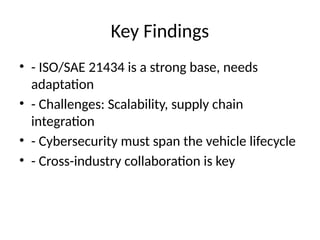
These and different world cyber security directives have had a significant impact on the greatest way OEMs and their suppliers develop and manage their products. UNR one hundred fifty five requires that OEMs implement a risk-based management framework (aka Cyber Security Administration System or CSMS) for detecting potential cyber threats and protecting autos against cyber assaults. ISO/SAE (“Road automobiles — Cybersecurity engineering”) is the central cybersecurity standard of the automotive industry. It describes an end-to-end cybersecurity engineering process across the whole automobile lifecycle — from idea and growth by way of production and operation to decommissioning.
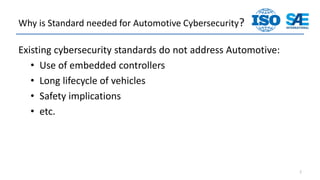
As previously talked about, ISO/SAE defines Risk Evaluation and Danger Assessment (TARA) to evaluate the cybersecurity dangers in the product. As proven in Figure 2, the four factors that aid in figuring out the chance rating are risk state of affairs, impact of the threat on the product, assault path, and the feasibility of executing the assault to score the chance. The threat rating is used to make an informed choice about how the chance needs to be handled. This normal may be seen as a companion of ISO (the practical security normal for road vehicles), but additionally addresses dangers from malicious cyberattacks on E/E techniques and their interactions. These risks have to be frequently recognized and managed to make certain that the automobile, driver, and other highway users remain secure in today’s fast-changing threat landscape.
Fields marked with * are required
Recent Comments